

This is what you need to know, if you want to learn German vocabulary in a truly efficient way
If you want to avoid frequent mistakes when you learn German vocabulary you HAVE to have a look at these tricks and learning aids!
But you’ve already known this for a long time, haven´t you? But now arises the master question:
HOW do you actually learn vocabulary? If you’ve understood how important it is to build your mental lexicon, then you should by all means have a very clear answer to this question, so here it is again:
HOW do you learn German vocabulary?
I have many years of experience as a teacher of German, and trust me, I know what I’m talking about. Most students of German don’t really think about THE WAY they should learn and therefore waste valuable potential.
Or maybe you make the effort to regularly write down vocabulary somewhere, but you’re actually too lazy to build a truly efficient system which enables you to expand your mental lexicon daily and continually. Let’s therefore have a look at the different possibilities:
Mistakes you should avoid at all cost
I know from my own experience that many students of German time and again write the important words somewhere down, in order to learn them „later“ :)
In reality, soon enough they don’t remember where they’ve actually written them down. Why? Because from the start they didn’t feel like writing down these spontaneous notes once again in a systematic way. A fatal mistake! The consequences?
Other students are more disciplined; and decide for themselves to always keep things nicely in order, and immediately write down all the important words in a VOCABULARY-NOTEBOOK. They always carry it with them and thus even „learn“ vocabulary on a regular base. Then suddenly they need a certain word, but nonetheless can’t remember it. WHY is this?
Disadvantages of the vocabulary-notebook
You surely know the solution to this yourself
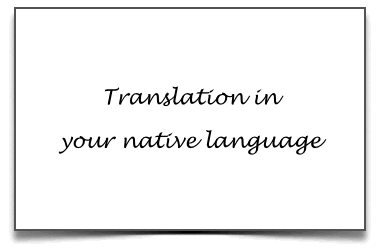
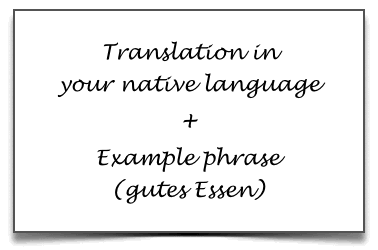
You must definitely work with flash cards! I know, many people don’t feel like writing their cards in a regular way, but hey! After all you want to learn German, and as quickly as possible. The learning of vocabulary is for this purpose an indispensable cornerstone. So, please make the effort and write down every word that you learn on a flash card. On the back, write down the translation in your mother tongue.

The only problem with cards is often that it takes a lot of work to write them and then afterwards, when you want to study them once more, some of the cards are lost.
The solution: Write your cards on the computer and you’ll find them every time again!
The given frame has exactly the same size as an A8-card.
Write your German vocabulary once on your computer
And here is the right way to write your cards Learn German nouns
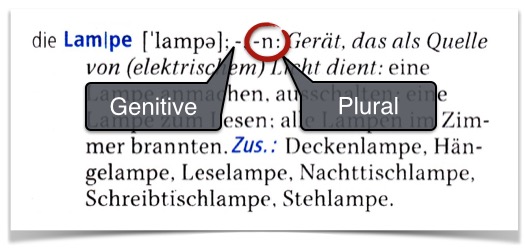
When learning nouns, you must definitely make sure that you ALWAYS include the article and the plural, when you write them down. You can find this information in a dictionary for German as a foreign language. In such a dictionary, the article always precedes the noun. After the noun you will find the ending of the genitive case and after that, the ending of the plural. In German there are 6 different possibilities to form the plural, therefore you always have to learn the plural together with the noun.
You find all the important information in the dictionary, a so called „Wörterbuch für Deutsch als Fremdsprache
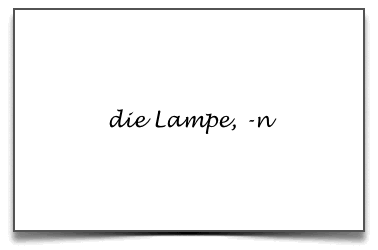
Here is what your flash cards should look like
Front
Back
Another important hint
Basically, you can learn in a better way, if you use as many senses as possible.
With this method of labeling, you link each word with a spatial correlation and therefore you’re able to remember it better.
The power of our spatial memory is very strong and it was discovered by a certain Simonides in ancient Greece. We owe the discovery and the development of mnemonics in the first place to him.

Learn German verbs
For sure, you already know that in German there are regular (weak) and irregular (strong) verbs. Therefore it’s not sufficient to only learn the infinitive of each verb. You have to learn at the same time also the past tense as well as the participles II (you need them to build the perfect tense). And on the back you should write an example-sentence in the 2nd person singular. Here, you will find a hint about how to write example-sentences containing special learning aids:
You will find all the important information in the dictionary for German as a foreign language:
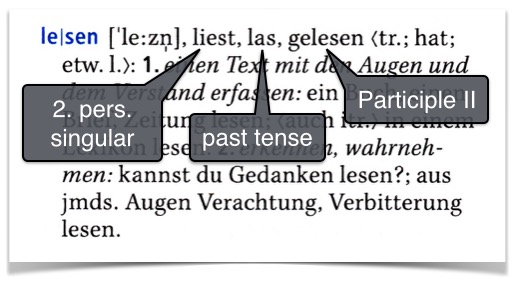
And this is what your learning cards for verbs should look like:
Front
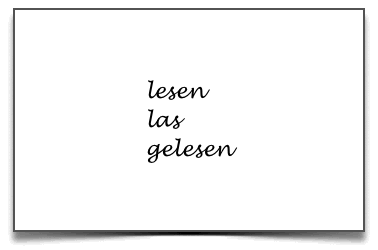
Back

Learn German Adjectives
Luckily, German adjectives are easier to learn than nouns and verbs, but here as well: there are regular (weak) and irregular (strong) adjectives. It all boils down to the form in which they are used. Therefore, with regards to the strong adjectives, you always need to learn the Comparative and the Superlative together with the adjective.
And as always, you can find all the important information in the dictionary for German as a foreign language.
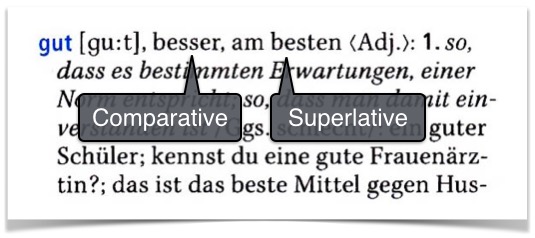
And this is what your flash cards should look like for learning German adjectives
Front
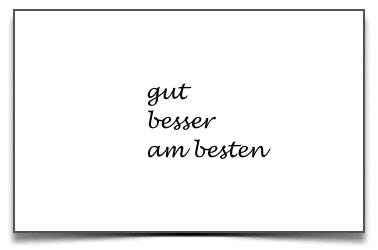
Back
Ok, it’s time for a few very important hints, which you definitely should know in order to learn German vocabulary
Learning German vocabulary with cards is really the best method I know, and I highly recommend it.
But you certainly know the feeling that it is nevertheless very difficult to memorize all this new information.
Therefore I will give you a few of my personal tricks, with which you’re guaranteed to learn more easily. You can combine all these aids with your card-system and in doing so you’ll be able to learn German in a really unbeatable, fast and organized way.
The American cognitive psychologist Richard Atkinson tested a mnemotechnique, as early as the 70ties, with which ALL THE EXPERIMENTAL SUBJECTS were able to learn vocabulary more easily; namely the so-called „keyword-method“. The method works in such way that you use your own mother tongue to learn the vocabulary of any language.
In my e-book „Learn German grammar with mnemonics“, I explain precisely and step by step how this super-technique as well as many other learning techniques for German grammar work.
Learning aids for German grammar
If you really want to learn German grammar, I would like to recommend you to use creative learning aids for German as a foreign language. In my FREE Video-Course "German Grammar for your Brain".