

Learning German Grammar – TENSES
The Pluperfect
In German, the Pluperfect is also called the Past Perfect. That sounds a little confusing so I shall explain:
The rule is that you normally only use the Pluperfect when talking about two actions in the past, one of which was already completed before the other one occurred. Said differently: I am reporting on an event that happened yesterday, for example. For this, I can use one of the past tenses e.g. the Perfect. So:
„Gestern habe ich eine Pizza gegessen. (Yesterday I ate a pizza.) Und VORHER habe ich meine Oma besucht. (And BEFORE THAT I visited my grandma).
The visit to Grandma was already finished when I ate the pizza. Now you could talk about both these events in one single sentence structure (main clause and subordinate clause). And that looks something like this:
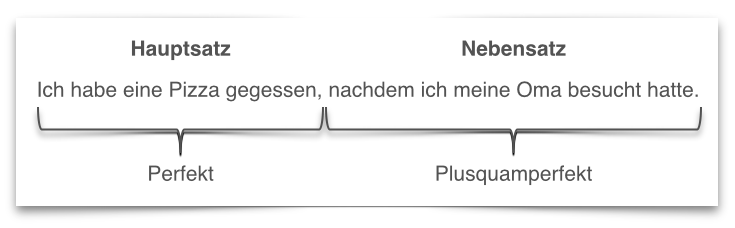
In this case you can also refer to it as a „vorzeitiger Nebensatz“, a subordinate clause, in which the action takes place BEFORE the action in the main clause, whereas the main clause already stands in the past or perfect tense.
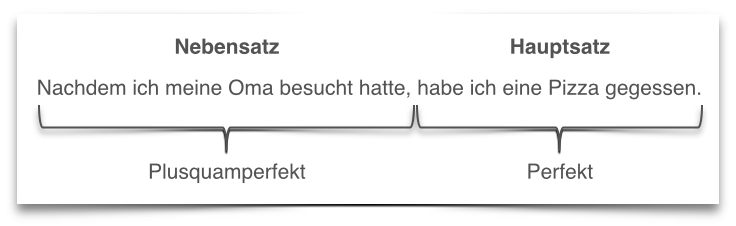
If you are learning the Pluperfect, you have surely already busied yourself with studying subordinate clauses. Then you also already know that the whole sentence structure can also begin with the subordinate clause. That looks something like this:
But there are also a few exceptions: sometimes people use it also simply instead of the Perfect or Simple Past (Imperfect). I myself am not sure whether I should interpret this as an example of colloquial language. On the other hand, if you write a whole text in the past tense, it can also be a good stylistic change to use the Pluperfect every now and again.
In any case I want to start by explaining to you how you build the Pluperfect with this example of the main clause „Vor vielen Jahren hatte ich mal Deutsch gelernt.“ (Many years ago I happened to learn German“:
Here is how you build the grammatical Tense of the Pluperfect
The rule for structuring the Pluperfect is as follows:
Auxiliary verb in the Simple Past (Imperfect) + Participle II (at the end of the sentence).
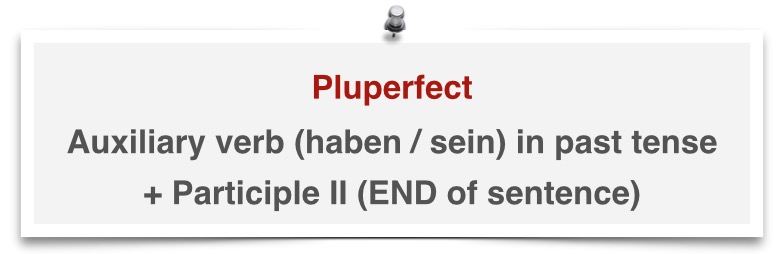
„Auxiliary verb“ means the same here as with the Perfect tense; it is the verb that helps us with creating the Pluperfect Tense and it is placed in second position in the main clause (where the conjugated verb ALWAYS is). This auxiliary verb on its own has no meaning, only a grammatical function.

Because of this there are basically only two possible verbs that you can use as an auxiliary verb for constructing the Pluperfect, namely the verb ‘haben’ (to have) and the verb ‘sein’ (to be). Do you recognize something already? Exactly! The rule for creating the Pluperfect is completely identical to the rule for creating the Perfect. The only difference is that the auxiliary verb ‘to have’ or rather ‘to be’ is in the Simple Past (Imperfect). So here is what happens:
What happens?
The verb ‘to learn’ is changed to Participle II and moves from second position to the END of the sentence, just like with the Perfect. Now in second position comes the auxiliary verb ‘to have’ in Simple Past (Imperfect), so „Ich hatte“.
But, like I said, because the Pluperfect is mostly used in subordinate clauses, you also have to observe the sentence structure rules concerning subordinate clauses. The conjugated verb always stands at the end!
The conjugated verb is, in our case, the auxiliary verb (to have/ to be) in the Simple Past (Imperfect). This goes to the end of the subordinate clause and therefore stands behind the Participle II.
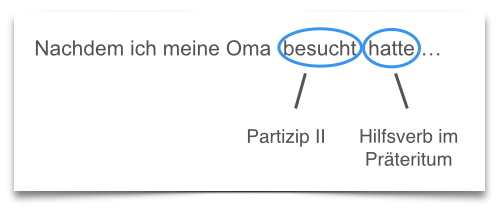
When do we use the auxiliary verb „sein“ (to be)?
The rules and also my learning aids are exactly the same for this as with the Perfect.
Exceptions
Also here the same rules apply as with the Perfect.
The verbs ‘to be’, ‘to have’ and the modal verbs (wollen, müssen, können usw.) are not used in the Pluperfect in German.
Never do you say: „Bevor ich ein Auto hatte, hatte ich ein Fahrrad gehabt.“ I have heard such or similar sentences once or twice before, but I can assure you that it is a fundamentally bad style. Never speak like that! :)
We would say: „Bevor ich ein Auto hatte, hatte ich ein Fahrrad.“ This is better.
Learning aids for German grammar
If you really want to learn German grammar, I would like to recommend you to use creative learning aids for German as a foreign language. In my FREE Video-Course "German Grammar for your Brain".