


Gotta learn German verbs with prepositions?
Here is how you can master it much more easy!
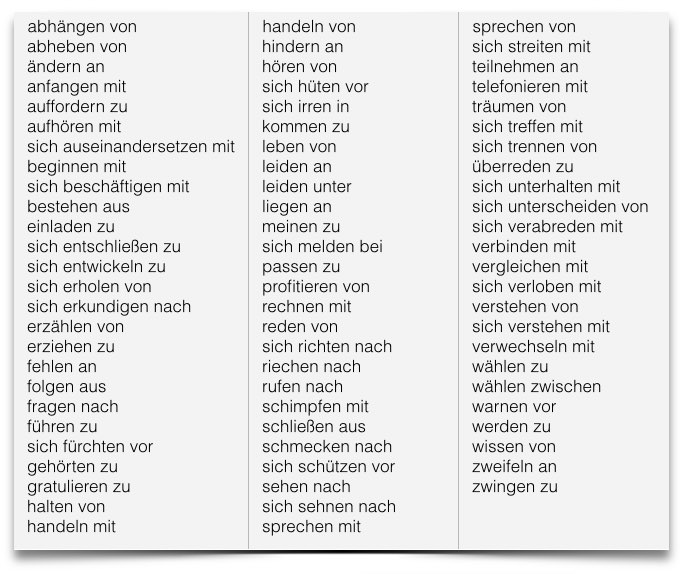
Learning German verbs can be a big problem for many students of German. Why? Because every verb has its own rule. Many German verbs are even connected with a specific preposition, these verbs are called „verbs with prepositions“.
If you want to find out exactly how a German verb works, you should have a look in a so called dictionary for German as a foreign language. Here is an example for a specific German verb with preposition, in this case the verb „warten auf“ (to wait for):
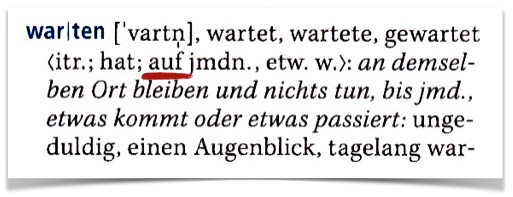
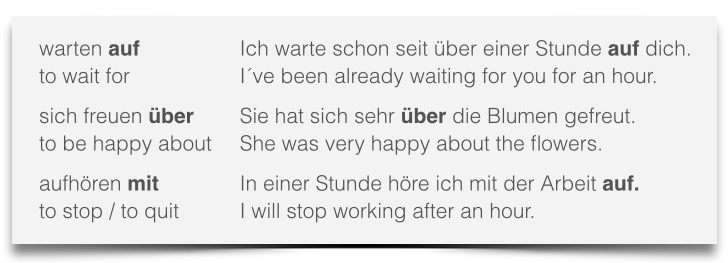
Uh! That’s pretty complicated, isn’t it? We need a few verbs with example sentences so you can understand better; this way you have to learn these verbs:
Mnemonic Sentences for Verbs With Prepositions

BUT:
These „normal“ example sentences don’t help students of German with the learning of the prepositions. Basically, when learning German verbs with prepositions, you have to learn which preposition each individual verb uses.
The problem:
When prepositions are used as a part of fixed phrases (as with the German verbs with prepositions) then they often lose their original meaning. The whole verb-phrase (verb + preposition) then receives a new meaning.
The consequence:
The connection verb + preposition is very hard to learn. And because there are so many prepositions, it will be even harder for you to learn than the noun + article connections!
Thus:

Here are a few examples for our three verbs:
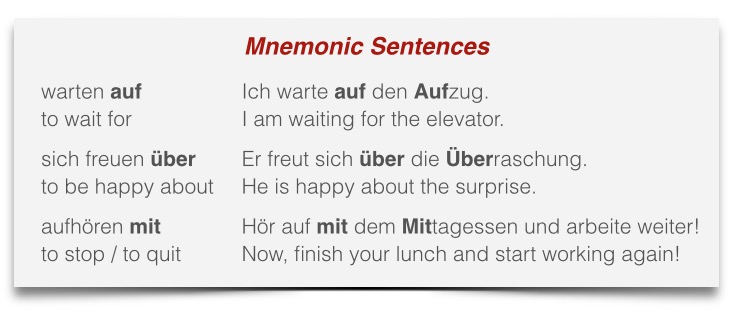
Why do these mnemonic key-words words work?
The trick is that normally these signal words are nouns, which are easy for you to picture. They are less abstract than the prepositions. It’s easier for our brain to understand them and to integrate them in a meaningful context, which means that we’re able to remember them.
You can also use a signal word of your mother tongue, if the beginning of the word sounds similar to the preposition that you want to learn. Just the similar sound of the signal word will dramatically facilitate the learning of the verbs with prepositions.
Now, you have to try to learn these verbs in the context of the mnemonic example sentence. Write the sentence on a flash card and take about five seconds for each verb in order to study the example sentence consciously. Try to picture the situation of the example sentence; visualize the situation. So you imagine you’re standing before an Aufzug (elevator) and wait. The Aufzug is something concrete, something that’s easier to remember than the abstract preposition „auf“. So if you’re able to remember the word Aufzug in your mnemonic example sentence, you will automatically know that the verb „warten“ uses the preposition „auf“!
The concept of using mnemonic example sentences in order to learn German verbs with prepositions is convincing!
But wait a moment!
It isn’t finished yet! Every preposition is followed by a noun in a certain case (accusative or dative case). Ouch, a lot more to come …
HOWEVER:
No problem! Click here, if
German verbs with preposition and accusative case

German verbs with preposition and dative case

Learn German Grammar With Mnemonics – The POWER-Learning-Kit!
For students AND teachers
Learning aids for German grammar
If you really want to learn German grammar, I would like to recommend you to use creative learning aids for German as a foreign language. In my FREE Video-Course "German Grammar for your Brain".