

With the help of mnemonic example sentence, learning German irregular verbs becomes really easy
But first of all: What is special about German irregular verbs?
Irregular German verbs or „strong“ verbs, as some people call them, are distinguished from so called „weak“ verbs, or, regular verbs.
For people who want to learn German it is usually really hard to learn those irregular verbs, because they change their stem vowel in the past tense (preterit) and perfect tense. Well, I know; so far it sounds a bit too abstract …
So let me give you a quick example for regular verbs at first
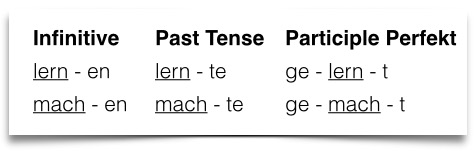
Irregular / strong verbs
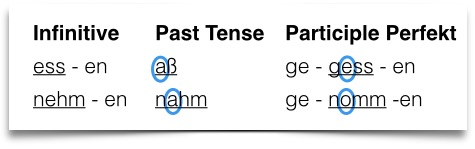
Irregular, or strong verbs behave differently. With the irregular verb “essen” (to eat), the stem vowel of the infinitive “e”, changes to “a” in the preterit tense and back to „e“ in the perfect tense. Moreover, these verbs often change their stem vowel in the 2nd and 3rd person singular in the present tense, too. For example, the verb “essen” is “ich esse” in the first person singular, but “du isst” in the 2nd person singular, and “er/sie/es isst” in the 3rd person singular. These changes of stem vowels are called “Ablaute” (vowel gradation).
The irregular verb “nehmen” (to take) changes its stem vowel as well in the preterit tense and in the perfect tense.

Regular/weak verbs or irregular/strong verbs? How can you recognize them?
Of course, your German teacher will tell you whether a German verb is strong or weak, but surely you want to be able to find out yourself. For this you urgently need a decent dictionary. With this I mean one that is appropriate for you as student of German. If you’re really serious about learning German, you’ll have to have in any case a monolingual dictionary in addition to your bilingual dictionary. And indeed one, which contains all the information that’s important for you! A simple German spelling manual is certainly not sufficient.
In this recently published dictionary “Wörterbuch Deutsch als Fremdsprache”, you find all the information you need to learn a correct German
For example, the regular verb “ordnen” (to order) presented is in this dictionary in the following way:
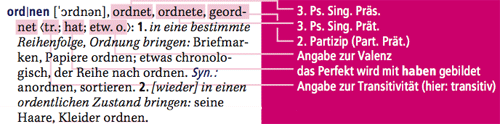
Irregular verbs are in principle presented in a similar way, you just have to make sure that you change the stem vowel.
Have a look yourself at an example of the same dictionary for the German irregular verb “essen”:
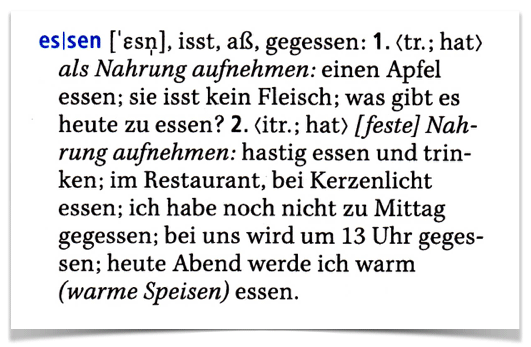
It’s very, very important that you’re able to look up this information, otherwise you won’t know whether you’re learning correct German or not. The problem with this is indeed, that it is very hard to learn this information. You have to write the corresponding verbs on cards in each case, and repeat the forms of the preterit tense and the perfect tense (participles) very often in order to learn the “Ablaute” (vowel gradations). I can tell you, this is one of those common situations, where the students ask their teacher: HOW can we learn this? And it is guaranteed the teacher will answer:
„No idea, you simply have to learn it in some or other way!„
That’s certainly not what you want to hear! OK, with a bit of luck, you’re given the advice to use cards. That’s all very well, but most likely you want a method, with which you can
bring structure to the chaos of the dictionary and with which you can REALLY learn “the easy way”
… and not in some or other way, but with a system – so that you DON´T HAVE TO REPEAT THINGS SO OFTEN! All well said, but how is it done?
What are mnemonic example-sentences?
Now, most of the time in dictionaries or in German lessons you will find an example-sentence together with the verb, so that you understand exactly what it means.
For the irregular verb “essen”, for instance you will find this example-sentence in the dictionary: “Sie isst kein Fleisch.” (She doesn´t eat meat) And: “Was gibt es heute zu essen?” (What are we having for lunch today?)
That’s all very well, but it doesn´t help with learning the vowel gradations of these strong verbs.
That’s where the mnemonic example-sentences come in!
Mnemonic example-sentences contain a mnemonic keyword, or a memory-trigger, which will help you to remember the vowel gradations while learning the strong verbs. Here is an example for you:
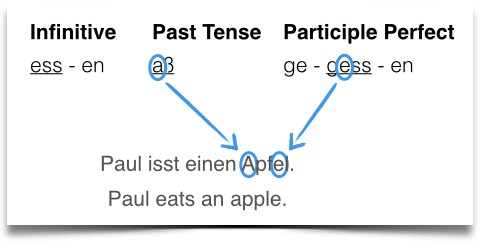
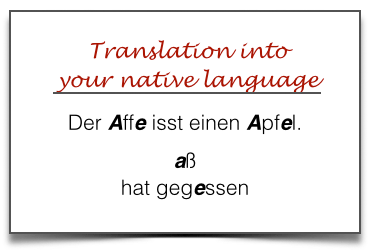
As you can see, the word “Apfel” is our mark-word. The mark-word can be any length you want, the important thing is that the two first vowels remind us of both vowel gradations of the irregular verb.
So if you can remember the mark-word of your example-sentence, which should be a lot easier to learn by heart than the abstract information in the dictionary, then you will automatically know the form of the verb in the past tense and the perfect tense (past participle).
Strong verbs often change their stem vowels in the 2nd and the 3rd person singular of the present tense. For this reason we use, in each example-sentence, a subject in the 2nd person or 3rd person singular, which reminds you that the verb “essen” becomes “isst” in these forms, and thus changes its stem vowel.
You could easily enhance the mnemonic effect by using even a second mnemonic keyword additionally to the other one. Make sure that the first two vowels of it must be the same as in the other keyword. For example, we could use the word „Affe“ (monkey) for the subject. Now our example sentence would look just like this:
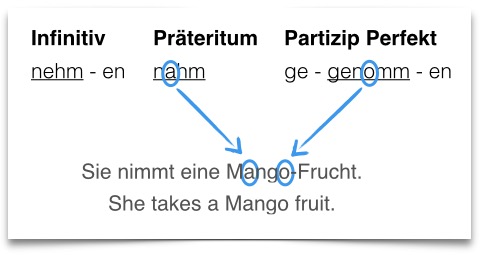
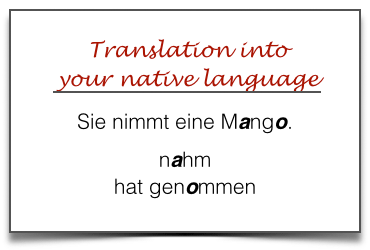
And here is another example for our second verb “nehmen”: (to take)
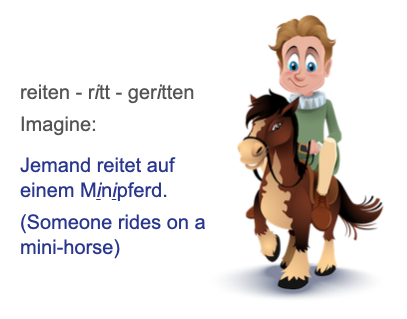
In a second step you should try to visualize your example-sentence. Don’t worry, you don’t have to be able to draw. It’s a lot more important that you use and practice your creative fantasy! Brain research has proven the following:
An intense imagination has just the same effect on our brain as a real perception!
We’ll try this with another example, with the irregular verb „reiten – ritt – geritten“ (to ride – rode ridden).
Use flash cards by all means!
These are the advantages:

Here is how you write your cards mnemonically right
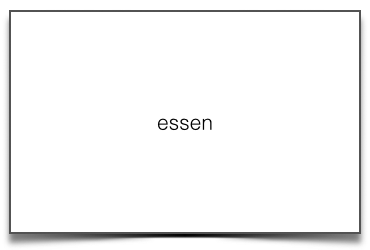
Of course, in the end it’s up to you how you want to write your cards. But if you want to apply the mnemotechnic presented here to the learning of German irregular verbs, I recommend simply copying me. Here is an example of how the flash cards for strong verbs such as “essen” (to eat) and “nehmen” (to take) would look like:
Front
Back
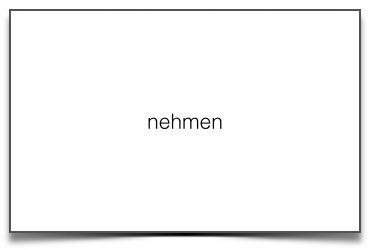
And also for our example-verb “nehmen” (to take):
Front
Front
I have two solutions for you!
First:
The mnemonic key-word doesn’t necessarily have to be German. You can even use any word of your mother tongue. The only thing that’s important is that the two first vowels sound the same as the German vowel gradations, which you have to learn. The meaning of the word doesn’t matter at all. In principle you can build in any noun you like in a mnemonic example-sentence. The only important thing is that you remember the corresponding vowel gradations later!
The second solution is a real screamer:
For the following list of 107 irregular verbs, I have mnemonic example-sentences completely ready for you! Yep, that´s right!
I have two solutions for you!
First:
The mnemonic key-word doesn’t necessarily have to be German. You can even use any word of your mother tongue. The only thing that’s important is that the two first vowels sound the same as the German vowel gradations, which you have to learn. The meaning of the word doesn’t matter at all. In principle you can build in any noun you like in a mnemonic example-sentence. The only important thing is that you remember the corresponding vowel gradations later!
The second solution is really cool:
For the following list of 107 irregular verbs, I have mnemonic example-sentences completely ready for you! Yep, that´s right!
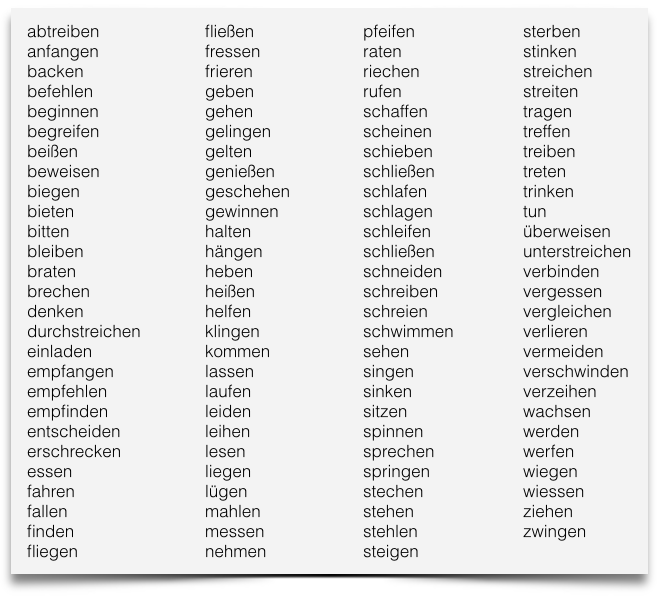
But it still gets better!
For this whole list of strong verbs, there are ready-to-use flash cards with mnemonic example-sentences! You only have to print them out and off you go … This way you can learn German in a much more relaxed way.
Learn German grammar with mnemonics –
The German POWER-Learning kit!
For students AND teachers
In this practice-ebook you will learn

Learning aids for German grammar
If you really want to learn German grammar, I would like to recommend you to use creative learning aids for German as a foreign language. In my FREE Video-Course "German Grammar for your Brain".