

What are mnemonics for learning German grammar?
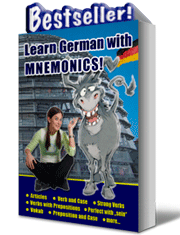
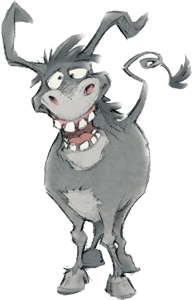 Roughly speaking, mnemonics are mental memory aids, so they are kinds of memory hooks (in German: Eselsbrücken, literally translated as „donkey bridges“). This is why you see a donkey on this website. He will symbolize this concept.
Here is an example of an „Eselsbrücke“: A lot of people who want to memorize the order of the planets of our solar system, simply learn the following sentence by heart: My Very Educated MotherJust Showed Us Nine Planets. The order of the planets is the following: Mercury, Venus, Earth, Mars, Jupiter, Saturn, Uranus, Neptune, Pluto.
In the next chapter I’ll explain how and why it works.
Why do mnemonics actually work (when learning German)?
The reason you’re able to remember EVERYTHING better with the use of mnemonics is because of a very simple principle:
Instead of pigheadedly repeating abstract information (in this case: the order of the planets) so many times that you finally know it by heart, we build a meaningful and understandable sentence with the initials of the individual elements. Once you’ve heard or read this sentence, you won’t easily forget it. With a simple trick, we learned very quickly the order of the planets of our solar system.
To most people it looks like magic, because with mnemonics it’s possible to memorize virtually EVERYTHING very easily. The explanation is very simple though. Meaningless information is quickly forgotten, because it’s not possible to integrate it in our memory. On the other hand, it is possible to link meaningful information with other information in our memory and therefore we are able to remember it a lot better. This phenomenon is also called „UNDERSTANDING“.
Below once more the most important principle of mnemonics:
By using simple tricks, meaningless subject content becomes meaningful and thus understandable, so that it stays in our memory with a lot less effort.
Now, you’ll probably wonder:
The answers to these questions are given here, if you read a bit further.
Where do mnemonics come from?
Plato (428 – 348 BC., the most famous student of Socrates, who gave rise to systematic western philosophy) designated the memory as the mother of the Muses in his dialogue „Theaetetus“ and her name was „Mnemosyne“. In English this simply means „memory“ or „commemoration“. In the 19th century, the word „mnemonics“ was formed from the connection of the name „Mnemosyne“ and „technique“. But let’s return to the 5th century BC once more:
According to a written record of Cicero, back then, a certain poet called Simonides (556-468) was invited by a friend to a banquet. During this banquet, a terrible accident happened: the whole banquet hall collapsed, and Simonides was the only survivor, because he wasn’t in the hall at that moment.
According to the written records of Cicero, Simonides was able to identify the unrecognizably bloodied, injured bodies because he could remember the seating arrangements. This experience led to his discovery of the principle of a mnemotechnique, by which mental images are created from memory contents and located at certain spots in your imagination. This resulted in the so-called loci-method. (loci = locations).
Since ancient times, new mental techniques have been developed continuously, in order to facilitate the systematic memorizing of information and to increase memory performance many times over.
This general memory art was brought to such a perfection, that there are now real „memory masters“. International championships take place on a regular basis, where the masters prove their incredible skills.
These days, when you enter „mnemonics“ in Google, you’ll encounter many websites on this topic. There is a huge demand for memory trainers, who charge a lot of money for hosting seminars for managers. Most of the time it concerns the learning by heart of names, historical data, phone numbers etc.
It certainly has little to do with the learning of a foreign language. Such general implementations of mnemonics aren’t very helpful when you want to learn German. So, let’s focus on the concrete question in which way mnemonics can be useful for learning a foreign language.
A humongous success in the learning of foreign languages!
In 1651, for the first time ever, a certain Johannes Buno authored a Latin grammar, which was provided with mnemonic memory aids throughout. He developed additional new techniques for this purpose and his Latin courses were an incredible success. In the context of my research, I’ve seen the original book in the Prussian State Library in Berlin and it is really incredible. Everywhere you find mnemonic images and other techniques, which often „burn“ the grammar rules into your memory at a glance.
Buno said himself that his students studied the Latin grammar with heart and soul and furthermore learned 2000 words in two months! But is such a thing actually realistic? Well, scientists have been researching this since 1975. Just keep reading, if you want to learn more about this …
The results of language acquisition research are unambiguous
In 1975 the American cognitive psychologist Richard Atkinson tested the so-called „mnemonic keyword-method“ on students of the Stanford University. In my e-book „Learn German grammar with mnemonics“ I explain how this method actually works.
During the experiments, the students had to learn Russian words. One group learned them by using the mnemonic keyword-method, the other group learned them in the conventional way, so without special learning tricks.
Atkinson summarized the study in the following way: „As a matter of fact, on each of the test days, the keyword-group learned more words in only two learning trials than the control group in three learning trials.“
When the students were once more tested 6 weeks later, the probability of the students in the group which learned by using mnemotechnics to giving a correct answer was more than 50 percent higher than that of the students of the control group!
This experiment attracted a lot of attention to the research of mnemonics for the acquisition of foreign languages. Nowadays scientists consider it uncontested, that these techniques are absolutely effective. A person who learns by using mnemotechnics is able to remember learning contents better than other persons who don’t use mnemotechnics.
But what does it actually look like for learning German?
Mnemotechnics for learning German grammar are unequivocally up and coming
Everybody who learns German, needs to learn a lot of abstract rules „simply by heart“. A big mistake of modern didactics is certainly the fact that they neglect the necessity of learning by heart. Instead they rather want students to understand what they learn.
At first sight, this sounds good, but the fact that there is nothing to understand about grammar rules is ignored. No one who learns German is able to UNDERSTAND why the verb „danken“ takes the dative. The Germans don’t understand this either, but they learned as a child to use it in the correct way. If you want to learn German now, you need to learn the rule: the verb „danken“ takes the dative“ by heart, one way or another.
I’ve been teaching German for many years and I can assure you that I haven´t yet encountered any student of German, who had an effective technique for learning this or any other rules. Hence there is much chaos in the heads of many students of German. It is no surprise that many of them are in despair …
In 1989 Horst Sperber published a doctoral thesis with the title „Deutsch lernen mit Mnemotechniken“ (learn German with mnemonics). In this work firstly he researches how often mnemotechnics are used in German classes and secondly how the use of mnemonics can be beneficial for the teaching and learning of German.
The results are unambiguous. Mnemonics for learning of German grammar are virtually unknown, and only on rare occasions are a few memory aids imparted during a course. There is nevertheless no doubt about the effectiveness of mnemotechnics for learning German. His conclusion is the following: – „The level of unawareness of these or similar techniques (= mnemotechnics) is regrettable, in light of these research results.“
Although you find some „learning tips“ in some German textbooks, they are very rare and often they are of so little use that they can’t be designated as mnemonics.
It’s sad that mnemotechnics for German as a foreign language are still an insider’s tip. But it’s also obvious that more and more students and teachers of German are discovering these techniques and have learned to love them. This website constitutes a vital contribution thereto.
Mnemonics in „learn-German-smarter“
Well, when I learned about mnemonics a few years ago, I couldn’t understand why there was nothing or very little available for the learning of German grammar. So I started to optimize the existing techniques for German as a foreign language and to develop new techniques at the same time.
It became clear to me that the development of mnemotechniques requires some creativity, and often students of German are overstrained. Therefore I have developed many applications that are ready to use and I’m continuously contriving more techniques, which can immediately be implemented by anyone.
I developed graphics for highly theoretical concepts, in cooperation with a professional illustrator, which will help you to learn German grammar rules „at a glance“, in the truest sense of the word, similar to Johannes Buno’s textbook in those days. Additionally you’ll find video materials, in which I explain certain rules very precisely and at the same time including extremely powerful memory aids. Once you’ve seen such images, it’s impossible to forget the rules again, even if you want to :)
This website offers the most innovative and effective materials on the theme of mnemotechnics for German as a foreign language, as far as I know. If you find something similar anywhere else, I’d like to ask you to inform me through my contact form. I’m always happy to learn about new advancements.
The opinions of the visitors of this website indicate clearly that for learning German, the future lies in mnemotechnics.
The whole concept of this website revolves around the development of techniques which enable you to REMEMBER the German grammar rules in a LASTING way.