

German Grammar – The Tenses
The Future Tense 2
Sounds pretty complicated doesn’t it?
That’s why I want to explain it to you in a simple, step-by-step manner. If you can grasp the principles and rules at the start, it won’t be so difficult when you come to use it.
Finally, I will explain to you how and in which situations the future tense 2 is used. But first let’s talk about the formation of the tense:
The Formation of the Future Tense 2
In a moment we’ll reshape the example sentence „Ich baue ein Haus“ (I am building a house).
As I already said, to do this we have to combine two different tenses with each other.
In order to understand this a little bit better it’s perhaps wise to mention that in German the future tense 2 is also known as „vollendete Zukunft“. The word „vollendet“ suggests to us that a past tense form is somehow incorporated: specifically here, the past perfect.
Our first step here is to put our example sentence into the past perfect. From there we will put it into the future tense 2. But first, here’s the example sentence in the perfect tense:
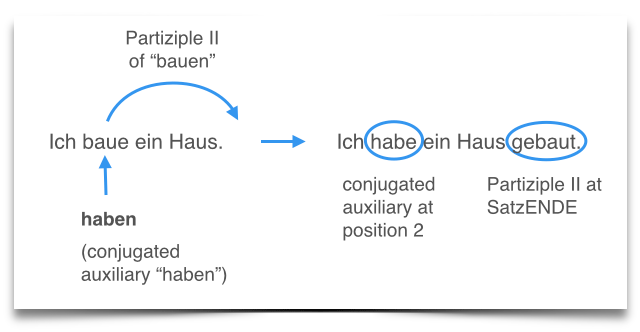

In the diagram above you can see that the conjugated verb in the second position moves to the end of the sentence and is put into its past participle form (bauen=> gebaut). In the second position in the sentence you then put the auxiliary verb “haben” in its conjugated form (in this case “habe”). I have covered exactly how the perfect tense works in German in the corresponding site about the perfect tense.
So after this first stage of putting the sentence into the perfect tense our example sentence looks like this:
The second step is to form the future tense using our perfect tense sentence. This sounds weird doesn’t it? This is how the simple rule goes:
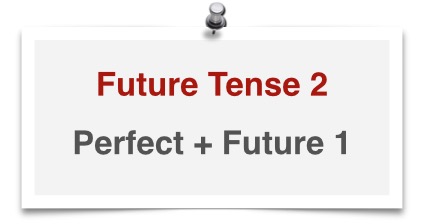
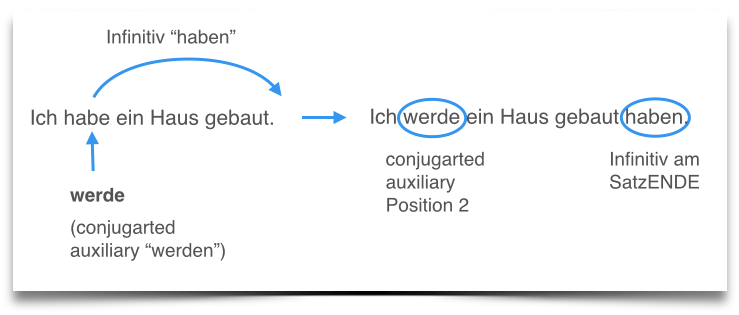
And this is exactly what we must do to reshape the sentence to be in the future tense. I have already explained the Rules for this in great detail. Just to remind ourselves: The conjugated verb in position 2 takes the infinitive form and is moved to the end of the sentence. In the newly empty position 2 you then put the conjugated form of the auxiliary verb “warden”.
And we’re finished already! Here’s a realistic way that you might use our sentence:
„Ich bin sicher: Im Alter von 40 Jahren werde ich ein Haus gebaut haben.“
(I am sure that at the age of 40 I will have built a house).
Attention!
Because the future tense 2 is always formed using the perfect tense, you must make sure that you remember that not all verbs take the auxiliary verb “haben” in the perfct tense and that some use the verb “sein”. You can read about the verbs that use “sein” here.
The verb “reisen” (to travel) is an example of a verb that uses the auxiliary verb “sein”. With this information we can form the following sentence in the future tense 2:
„Im Alter von 60 Jahren werde ich einmal um die Welt gereist sein!“
(By the time I’m 60 I will have travelled once around the world!)
As you can see, the infinitive form of “haben” is not at the end of the sentence. Instead you have the infinitive form of “sein” because in the perfect tense “reisen” takes the auxiliary verb “sein”.
Usage of the Future Tense 2
The way that we use the future tense 2 is very similar to how we use the future tense 1, in that we use sentences like the examples above very infrequently. We would use sentences like the examples above when talking about our visions for the future or when we are predicting something. They often sound a bit dramatic:
- In zwei Jahren werde ich endlich meine Ausbildung beendet haben! (In two years I will finally have finished my training!)
- Wenn ich einmal in Pension gehe, werde ich gut vorgesorgt haben. (When I take my pension, I will have taken good precautions.)
It is much more likely that you will use the future 2 in combination with a negation such as “nicht, nichts or kein”. Namely, when we want to express a hope or a suggestion about something that has already happened. Here are some examples:
- Er ist nun schon seit zwei Stunden weg, ich mache mir Sorgen! Ach was, es wird schon nichts passiert sein! (He has been away for two hours now. I’m worried! Ahh, nothing will have happened.)
- Sie hatte heute Führerscheinprüfung und hat sich noch nicht gemeldet! Sie wird doch nicht durchgefallen sein! (She had her driving test today and has not reported back! She will not have failed though!)
- Der kleine Junge ist heute so schüchtern. Er wird doch nichts Schlimmes angestellt haben! (The small boy is so shy today. He will not have done anything bad though!)
These three example sentences are very realistic. When we are worried that something might have happened, the future tense 2 provides us with the perfect way to express ourselves.
Learning aids for German grammar
If you really want to learn German grammar, I would like to recommend you to use creative learning aids for German as a foreign language. In my FREE Video-Course "German Grammar for your Brain".